Ghada Mohammad Abo Elfadl1, Golnar Mohammed Fathy1, Mohamed Talaat Mohamed1, Haidy Talaat Elyass1, Ahmad Mohamed Aboelfadl2, Marwa Mahmoud Abdel Rady3
 ORCID
ORCID
Recibido: 2026-01-16
Aceptado: 2026-05-14
©2026 El(los) Autor(es) – Esta publicación es Órgano oficial de la Sociedad de Anestesiología de Chile
Revista Chilena de Anestesia Vol. Núm. | https://doi.org/10.25237/revchilanestv55n5-13
PDF
Dexametasona en la prevención de ileo paralítico luego de una cesárea: Estudio controlado randomizado
Abstract
Background: Postoperative ileus (POI) delays recovery after cesarean section. This study evaluated whether intravenous dexamethasone accelerates gastrointestinal recovery after cesarean delivery under spinal anesthesia. Methods: Ninety ASA II parturients scheduled for elective or semi-elective cesarean section under spinal anesthesia were randomized to receive either intravenous dexamethasone 8 mg (Group D) or normal saline (Group C) immediately after spinal anesthesia. The primary outcome was time to first passage of flatus. Secondary outcomes included time to first defecation, return of bowel sounds, hemodynamic stability, adverse effects, and patient satisfaction. Results: Time to first flatus and return of bowel sounds were significantly shorter in Group D compared with Group C. Time to first defecation was earlier in Group D, but did not reach statistical significance. Patient satisfaction was significantly higher in Group D. No clinically relevant differences in hemodynamic parameters or serious adverse events were observed. Conclusion: A single intravenous dose of dexamethasone 8 mg accelerated early gastrointestinal recovery after cesarean section under spinal anesthesia without increasing adverse effects.
Resumen
Background: Postoperative ileus (POI) delays recovery after cesarean section. This study evaluated whether intravenous dexamethasone accelerates gastrointestinal recovery after cesarean delivery under spinal anesthesia. Methods: Ninety ASA II parturients scheduled for elective or semi-elective cesarean section under spinal anesthesia were randomized to receive either intravenous dexamethasone 8 mg (Group D) or normal saline (Group C) immediately after spinal anesthesia. The primary outcome was time to first passage of flatus. Secondary outcomes included time to first defecation, return of bowel sounds, hemodynamic stability, adverse effects, and patient satisfaction. Results: Time to first flatus and return of bowel sounds were significantly shorter in Group D compared with Group C. Time to first defecation was earlier in Group D, but did not reach statistical significance. Patient satisfaction was significantly higher in Group D. No clinically relevant differences in hemodynamic parameters or serious adverse events were observed. Conclusion: A single intravenous dose of dexamethasone 8 mg accelerated early gastrointestinal recovery after cesarean section under spinal anesthesia without increasing adverse effects.
Introduction
Postoperative ileus (POI) remains a common and challenging complication in surgical practice. Although it is classically associated with abdominal surgery, POI may also occur after procedures performed under general or regional anesthesia, including cesarean section[1],[2]. POI is characterized by a transient impairment of gastrointestinal motility, leading to reduced or absent intestinal peristalsis. Clinically, it manifests as abdominal distension, pain, nausea, vomiting, delayed passage of flatus and stool, and intolerance of oral intake[3]-[5].
The development of POI is clinically significant, as it contributes to patient discomfort, increases postoperative morbidity, prolongs hospital stay, and imposes a substantial economic burden on healthcare systems[4],[6],[7]. Consequently, early recovery of gastrointestinal function has become a key goal of enhanced recovery protocols following surgery. The pathophysiology of POI is multifactorial and involves complex interactions between neural, inflammatory, and hormonal pathways. Surgical stress and tissue injury activate the sympathetic nervous system and trigger an inflammatory cascade, resulting in increased release of pro-inflammatory mediators such as interleukin-6. These processes impair intestinal smooth muscle activity and delay gastrointestinal transit. Additional contributing factors include disruption of the intestinal barrier, autonomic imbalance, and postoperative opioid use[1],[5],[8],[9]. According to some research, postoperative analgesia can be guaranteed, and the effect of intraoperative opioid use on POI can be eliminated by using either short-acting opioids or opioid receptor antagonists. POI recovery can be improved by adjuvant epidural analgesia, intraoperative fluid restriction, decreased intraoperative blood loss, and early oral nutrition supplementation following surgery[10]. POI is still a medical issue during clinical surgery, though, thus a more efficient and noninvasive approach is needed.
Several strategies have been proposed to mitigate POI, including opioid-sparing analgesic techniques, epidural anesthesia, intraoperative fluid optimization, reduction of surgical blood loss, and early postoperative oral feeding[10]. Despite these measures, POI remains a persistent clinical problem, highlighting the need for additional effective and minimally invasive preventive approaches. Dexamethasone is a potent corticosteroid with anti-inflammatory and immunomodulatory properties, exhibiting glucocorticoid activity substantially greater than that of cortisol and prednisone. In clinical practice, dexamethasone is widely used for its anti-inflammatory, antiemetic, and analgesic-sparing effects[10].
Its mechanism of action is multifactorial and includes suppression of inflammatory cytokine transcription, particularly interleukin-6, attenuation of the innate immune response, and modulation of central nervous system pathways. These effects have been shown to reduce systemic and local inflammatory responses, as reflected by decreased plasma and peritoneal cytokine levels and altered leukocyte counts[11]. Given the central role of inflammation in the development of POI, the anti-inflammatory and immunomodulatory effects of dexamethasone provide a biologically plausible rationale for its use in accelerating postoperative gastrointestinal recovery. However, data regarding its effect on POI following cesarean section under spinal anesthesia remain limited. Therefore, the present study aimed to evaluate the effect of a single intravenous dose of 8 mg dexamethasone on postoperative gastrointestinal recovery, specifically the duration of paralytic ileus, in patients undergoing cesarean section under spinal anesthesia.
Study design and ethical approval
This prospective, randomized, comparative, double-blind study was conducted at Assiut University Hospital, Assiut, Egypt. Ethical approval was obtained from the Faculty of Medicine Research Ethics Committee, Assiut University (approval number: 17101960). The study was registered at ClinicalTrials.gov (NCT05654649) and conducted in accordance with the Declaration of Helsinki and CONSORT guidelines. Written informed consent was obtained from all participants after explanation of the study objectives, procedures, and the right to withdraw at any time without affecting medical care.
Inclusion criteria:
Patients were eligible for inclusion if they met the following criteria:
Age between 18 and 40 years.
Full-term singleton pregnancy (37-41 weeks).
ASA physical status II.
Scheduled for elective or semi-elective cesarean section (category 3 or 4).
Planned spinal anesthesia.
Exclusion Criteria:
Patients were excluded if they had:
Height <150 cm or >180 cm, or BMI >35 kg/m2.
Contraindications to or refusal of spinal anesthesia.
Pre-existing gastrointestinal disorders, including paralytic ileus.
Chronic constipation or use of laxatives within one week before surgery.
Cardiovascular disease (including arrhythmias or severe valvular disease).
Renal or hepatic disease, coagulopathy, or neurological disorders.
Increased intracranial pressure.
High-risk pregnancy (e.g., preeclampsia).
History of postoperative nausea and vomiting, motion sickness, or use of antiemetics within one week.
Use of β-adrenergic blockers or medications affecting gastrointestinal motility.
Known allergy to any study drug. Prolonged operative time (> 50 minutes).
Ninety patients were randomly allocated into two equal
groups (45 patients each) using a computer-generated randomization sequence. Allocation concealment was achieved using opaque, sealed, sequentially numbered envelopes. An anesthesiologist not involved in patient management or data collection performed the randomization. Study medications were prepared in identical syringes by a researcher not involved in data collection. Patients, anesthesiologists, surgeons, ward nurses, and outcome assessors were blinded to group allocation throughout the study. Group D (Dexamethasone group): received 8 mg dexamethasone diluted in 5 mL normal saline intravenously. Group C (Control group): received 5 mL of normal saline intravenously.
Anesthetic and surgical technique
All patients fasted for at least 6 hours before surgery. Standard monitoring was applied in the operating room, including non-invasive blood pressure, electrocardiography, and pulse oximetry. An intravenous line was established, and patients received lactated Ringer’s solution 10 mL/kg as a preload. Spinal anesthesia was performed in the sitting position at the L3–L4 interspace using a 25-gauge Quincke needle under aseptic conditions.
A standardized intrathecal mixture of hyperbaric bupivacaine 0.5% (12.5 mg) combined with morphine 40 µg was administered after free flow of cerebrospinal fluid was confirmed. Immediately after successful spinal anesthesia, the pre-prepared study syringe was administered intravenously according to group allocation. Patients were positioned supine with a left uterine displacement using a wedge under the right hip. Oxygen was administered via face mask at 4 L/min. Surgery commenced once a sensory block level of at least T6 was achieved. A standardized lower-segment transverse cesarean section technique was used in all patients. Cases with failed spinal block were excluded and managed with general anesthesia.
Intraoperative and postoperative management
Heart rate, mean arterial blood pressure, and oxygen saturation were recorded at baseline, then at regular intraoperative intervals, and every two hours for 24 hours postoperatively. Hypotension (MAP < 60 mmHg) and bradycardia (HR < 60 bpm) were treated with ephedrine 6 mg and atropine 0.6 mg, respectively. Nausea and vomiting were treated with ondansetron 4 mg IV if required.
Assessment of gastrointestinal function
Postoperative gastrointestinal function was assessed by trained ward nurses blinded to group allocation, with confirmation by an anesthesiologist during routine rounds. Bowel sounds were assessed every 4 hours. Time to first passage of flatus and time to first defecation were recorded in hours. Patients who did not pass flatus within 48 hours received conservative measures (abdominal massage and oral fluids). Intravenous nutrition was considered if flatus had not occurred after 72 hours.
Outcome measures
Primary outcome:
Time to first passage of flatus.
Secondary outcomes
Time to first defecation.
Return of bowel sounds.
Hemodynamic stability.
Incidence of adverse effects.
Patient satisfaction score.
Patient satisfaction was assessed using a 5-point Likert scale at the end of follow-up.
Sample size calculation
Sample size was calculated using G*Power software (version 3.1.9.7) based on detecting a clinically significant difference in gastrointestinal recovery between groups. Assuming an effect size of 0.6, a power of 90%, and a one-tailed alpha error of 0.05, a minimum of 84 patients (42 per group) was required. To compensate for potential dropouts, three additional patients were added to each group.
Statistical analysis
Data were analyzed using IBM SPSS Statistics version
20. Normality was assessed using the Shapiro–Wilk test. Continuous variables were expressed as mean ± standard deviation or median (range) as appropriate and compared using Student’s t-test or Mann-Whitney U-test. Categorical variables were expressed as numbers and percentages and analyzed using the chi-square test. A p-value < 0.05 was considered statistically significant.
Results
A total of 97 patients were assessed for eligibility. Five patients did not meet the inclusion criteria, and two patients declined participation. Consequently, 90 patients were randomized, with 45 patients in each group completing the study and included in the final analysis (Figure 1).
Baseline characteristics
There were no statistically significant differences between the dexamethasone group (Group D) and the control group (Group C) regarding age, weight, height, duration of surgery, or duration of anesthesia (p > 0.05 for all comparisons) (Table 1).
Hemodynamic parameters
Baseline heart rate and mean arterial blood pressure were comparable between the two groups before spinal anesthesia. Throughout the intraoperative and postoperative periods, no statistically significant differences were observed between the groups in heart rate, mean blood pressure, or oxygen saturation at any recorded time point (p > 0.05). Hemodynamic data are therefore not presented in tabular form.
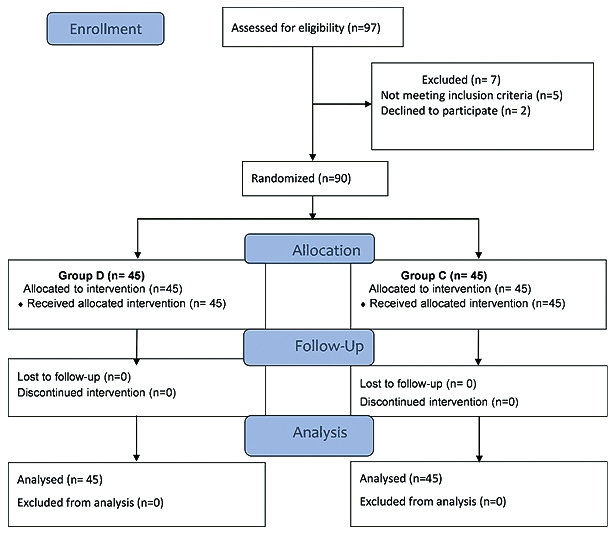
Figure
Consort flow diagram.
Table 1. Baseline demographic and operative characteristics
| Group D (n = 45) | Group C (n = 45) | Pvalue | |
|---|---|---|---|
| Age (years) | 27.4 ± 5.6 | 25.8 ± 4.7 | 0.171 |
| Weight (kg) | 77.6 ± 7.5 | 75 ± 7.3 | 0.105 |
| Height (cm) | 162.2 ± 3.9 | 161.8 ± 4.2 | 0.587 |
| Duration of operation (min) | 47.9 ± 5.9 | 49.9 ± 9 | 0.206 |
| Duration of anesthesia (min) | 236.8 ± 61.1 | 220.8 ± 45.5 | 0.162 |
Group D: Dexamethasone group; Group C: control group; Data presented as Mean ± SD; P > 0.05 considered statistically nonsignificant;
*P < 0.05 considered statistically significant, analysis done by Independent-Samples Mann-Whitney U Test.
Gastrointestinal recovery
A significantly higher proportion of patients in Group D passed flatus within the observation period compared with Group C (95% vs. 82.2%, p = 0.004). Additionally, the time to first passage of flatus was significantly shorter in the dexamethasone group than in the control group (8.6 ± 3.8 hours vs. 12.1 ± 5.9 hours, p = 0.001).
Table 2. Gastrointestinal recovery outcomes and length of hospital stay
| Group D (n = 45) | Group C (n = 45) | Pvalue | |
|---|---|---|---|
| Number of patients passing flatus | 43 (95%) | 37 (82.2%) | 0.004* |
| Passage of flatus (h) | 8.6 ± 3.8 | 12.1 ± 5.9 | 0.001* |
| Number of patients passing stool (%) | 11 (24.4%) | 3 (6.7%) | 0.020* |
| Passage of stool (h) | 12.4 ± 5 | 15.5 ± 6.6 | 0.014* |
| Return of intestinal sound n (%) | 44 (97.8%) | 36 (80%) | 0.007* |
| Return of intestinal sound (h) | 4.8 ± 3.5 | 8.2 ± 5.6 | 0.001* |
| Length of stay in hospital < 24 h n (%) | 43 (95%) | 39 (86.7%) | 0.138 |
Group D: Dexamethasone group; Group C: control group; Data presented as Mean ± SD; No (%); P > 0.05 considered statistically nonsignificant; *P < 0.05 considered statistically significant, analysis done by Chi-Square Test &Independent-Samples Mann-Whitney U Test. 3.5 hours vs. 8.2 ± 5.6 hours, p = 0.001).
Similarly, a greater number of patients in Group D passed stool compared with Group C (24.4% vs. 6.7%, p = 0.020), and the time to first defecation was significantly shorter in Group D (12.4 ± 5.0 hours vs. 15.5 ± 6.6 hours, p = 0.014). Return of intestinal sounds occurred in a significantly larger proportion of patients in Group D than in Group C (97.8% vs. 80%, p = 0.007), and the time to return of bowel sounds was significantly shorter in the dexamethasone group (4.8 ± 3.5 hours vs. 8.2 ± 5.6 hours, p = 0.001).
The number of patients discharged within 24 hours was higher in Group D than in Group C; however, this difference did not reach statistical significance (p = 0.138) (Table 2).
Adverse effects
No significant differences were observed between the two groups in most recorded adverse effects. However, hypotension occurred significantly less frequently in the dexamethasone group compared with the control group. All reported adverse effects in both groups were mild, self-limiting, and did not require specific medical intervention (Figure 2).
Patient satisfaction
Patient satisfaction scores, assessed using a 5-point Likert scale, were significantly higher in Group D. A total of 93.3% of patients in the dexamethasone group reported satisfaction (very satisfied, satisfied, or neutral), compared with 66.6% in the control group, with a statistically significant difference between groups (p = 0.001) (Figure 3).
Discussion
Early recovery of gastrointestinal function after surgery is clinically important, as postoperative ileus (POI) is associated with increased maternal discomfort, delayed feeding, prolonged hospital stay, and higher healthcare costs. In this randomized, double-blind controlled study, administration of a single intravenous dose of 8 mg dexamethasone was associated with earlier recovery of gastrointestinal motility following elective cesarean section under spinal anesthesia, as evidenced by shorter time to first flatus, earlier return of bowel sounds, and earlier passage of stool. The development of POI is known to be multifactorial. Surgical stress and tissue manipulation activate inflammatory pathways and autonomic imbalance, leading to suppression of intestinal peristalsis. Previous experimental and clinical studies have demonstrated that inflammation plays a central role in the pathogenesis of POI, particularly through the release of pro-inflammatory cytokines such as interleukin-6[12].
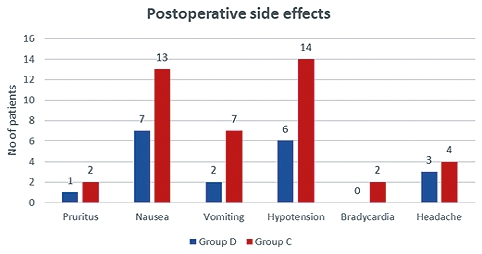
Figure 2. Postoperative side effects between both groups.
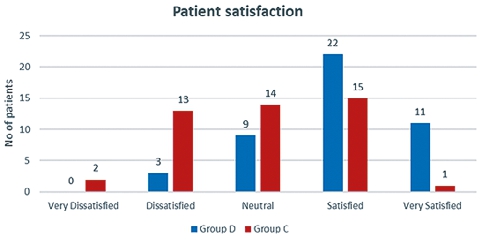
Figure 3. Patient satisfaction.
In this context, the anti-inflammatory properties of dexamethasone provide a biologically plausible explanation for the observed improvement in postoperative gastrointestinal recovery. The beneficial effects of dexamethasone are likely mediated through several mechanisms. These include attenuation of the inflammatory response, suppression of cytokine release, modulation of central nervous system pathways, and indirect effects such as reduction of postoperative pain and nausea[13],[14],[15],[16],[17]. Collectively, these effects may facilitate earlier mobilization and restoration of bowel function.
Although inflammatory markers were not measured in the present study, the clinical findings are consistent with these proposed mechanisms. In the present study, hemodynamic parameters remained stable, with no significant differences between the dexamethasone and control groups throughout the intraoperative and postoperative periods.
These findings are consistent with previous reports in obstetric anesthesia, including the study by Mohamed et al., who demonstrated that intravenous dexamethasone did not adversely affect maternal hemodynamics during cesarean section[18]. Our findings regarding gastrointestinal recovery agree with studies conducted in non-obstetric surgical populations. Chen et al., reported earlier passage of flatus in patients undergoing colorectal surgery who received dexamethasone, although the effect on bowel movement and length of hospital stay was less pronounced[19].
Similarly, Zhang et al., demonstrated improved gastrointestinal recovery and a shorter hospital stay in patients with inflammatory bowel disease undergoing surgery, findings broadly consistent with our results[20]. Differences between studies may be attributed to variations in surgical procedures, patient populations, and baseline risk profiles. Regarding adverse effects, dexamethasone was well-tolerated in the present study. No serious complications were observed, and the overall incidence of side effects was comparable between groups, with hypotension occurring less frequently in the dexamethasone group.
These findings are consistent with previous obstetric and surgical studies reporting a favorable safety profile for single-dose perioperative dexamethasone[19],[20],[21],[22]. In contrast to our results, Maged et al. found that the pain score in the IV dexamethasone group was significantly lower than that in the control group. This difference may be attributed to the different dexamethasone doses, as they used 16 mg dexamethasone as an IV drip, while we used 8 mg dexamethasone as an IV drip[23].
Patient satisfaction was significantly higher in the dexamethasone group. This finding may reflect improved overall postoperative comfort related to earlier gastrointestinal recovery and the known antiemetic and analgesic-sparing effects of dexamethasone. Differences between our findings and those of other studies reporting no effect on satisfaction may be related to variations in dexamethasone dose, timing of administration, and outcome assessment tools[24]. Shoshtari et al., also concluded that it could shorten the length of postoperative stay (by 1 day) and the probability of discharge on day 3 of the first hospital day,(25) which is consistent with the results of our study, although with no statistically significant.
Limitations
This study has several limitations. First, it was conducted at a single center and included a relatively select population of healthy parturients, which may limit generalizability. Patients with diabetes, severe hypertension, and emergency cesarean sections were excluded, despite these factors potentially influencing gastrointestinal recovery. Second, inflammatory biomarkers were not measured, and therefore, mechanistic conclusions cannot be directly confirmed. Finally, although the study was adequately powered for the primary outcome, it may have been underpowered to detect small differences in some secondary outcomes.
Conclusion
In conclusion, a single intravenous dose of 8 mg dexamethasone administered after spinal anesthesia was associated with earlier recovery of gastrointestinal motility in women undergoing elective cesarean section, without an increase in adverse effects. These findings suggest that dexamethasone may be a useful adjunct in enhancing postoperative recovery following cesarean delivery. Further multicenter studies with broader patient populations are warranted to confirm these results.
Acknowledgements: The authors gratefully acknowledge the assistance of all gynecological consultants, nurses, residents, and other surgical theatre personnel.
Referencias
1. Deng WW, Lan M, Peng AF, Chen T, Li ZQ, Liu ZL, et al. The risk factors for postoperative ileus following posterior thoraco-lumbar spinal fusion surgery. Clin Neurol Neurosurg. 2019;184:105411. https://doi.org/10.1016/j.clineuro.2019.105411 PMID: https://pubmed.ncbi.nlm.nih.gov/31310924.
2. Petca A, Borislavschi A, Dumitrascu MC, Sandru F, Geoarsa M, Petca RC. Postoperative ileus complicated with incomplete evisceration after hysterectomy for benign pathology. Chirurgia. 2020;115(1):112-9. https://doi.org/10.21614/chirurgia.115.1.112 PMID: https://pubmed.ncbi.nlm.nih.gov/32155406.
3. Holte K, Kehlet H. Postoperative ileus: a preventable event. British Journal of surgery. 2000;87(11):1480-93.
4. Tevis SE, Carchman EH, Foley EF, Harms BA, Heise CP, Kennedy GD. Postoperative ileus-more than just prolonged length of stay? Journal of Gastrointestinal Surgery. 2015;19(9):1684-90. https://doi.org/10.1007/s11605-015-2877-1 PMID: https://pubmed.ncbi.nlm.nih.gov/26105552.
5. Venara A, Neunlist M, Slim K, Barbieux J, Colas P, Hamy A, et al. Postoperative ileus: Pathophysiology, incidence, and prevention. Journal of visceral surgery. 2016;153(6):439-46. https://doi.org/10.1016/j.jviscsurg.2016.08.010 PMID: https://pubmed.ncbi.nlm.nih.gov/27666979.
6. Iyer S, Saunders WB, Stemkowski S. Economic burden of postoperative ileus associated with colectomy in the United States. Journal of Managed Care Pharmacy. 2009;15(6):485-94. https://doi.org/10.18553/jmcp.2009.15.6.485 PMID: https://pubmed.ncbi.nlm.nih.gov/19610681.
7. Asgeirsson T, El-Badawi KI, Mahmood A, Barletta J, Luchtefeld M, Senagore AJ. Postoperative ileus: it costs more than you expect. Journal of the American College of Surgeons. 2010;210(2):228-31. https://doi.org/10.1016/j.jamcollsurg.2009.09.028 PMID: https://pubmed.ncbi.nlm.nih.gov/20113944.
8. Chapuis PH, Bokey L, Keshava A, Rickard MJ, Stewart P, Young CJ, et al. Risk factors for prolonged ileus after resection of colorectal cancer: an observational study of 2400 consecutive patients. Annals of surgery. 2013;257(5):909-15.
9. Bragg D, El-Sharkawy AM, Psaltis E, Maxwell-Armstrong CA, Lobo DN. Postoperative ileus: recent developments in pathophysiology and management. Clinical Nutrition. 2015;34(3):367-76. https://doi.org/10.1016/j.clnu.2015.01.016 PMID: https://pubmed.ncbi.nlm.nih.gov/25819420.
10. Kehlet H, Wilmore DW. Evidence-based surgical care and the evolution of fast-track surgery. Annals of surgery. 2008;248(2):189-98. https://doi.org/10.1097/sla.0b013e31817f2c1a PMID: https://pubmed.ncbi.nlm.nih.gov/18650627.
11. Ritter KA, Burke JP, Stocchi L, Aiello A, Holubar S, Ashburn JH, et al. Postoperative Steroid Taper Is Associated With Pelvic Sepsis After Ileal Pouch-anal Anastomosis. Inflamm Bowel Dis. 2019;25(8):1383-9. https://doi.org/10.1093/ibd/izy388 PMID: https://pubmed.ncbi.nlm.nih.gov/30597024.
12. The FO, Bennink RJ, Ankum WM, Buist MR, Busch OR, Gouma DJ, et al. Intestinal handling-induced mast cell activation and inflammation in human postoperative ileus. Gut. 2008;57(1):33-40. https://doi.org/10.1136/gut.2007.120238 PMID: https://pubmed.ncbi.nlm.nih.gov/17591620.
13. Ho CM, Wu HL, Ho ST, Wang JJ. Dexamethasone prevents postoperative nausea and vomiting: benefit versus risk. Acta Anaesthesiol Taiwan. 2011;49(3):100-4.
14. Holte K, Kehlet H. Perioperative single-dose glucocorticoid administration: pathophysiologic effects and clinical implications. J Am Coll Surg. 2002;195(5):694-712. https://doi.org/10.1016/s1072-7515(02)01491-6 PMID: https://pubmed.ncbi.nlm.nih.gov/12437261.
15. Zargar-Shoshtari K, Sammour T, Kahokehr A, Connolly AB, Hill AG. Randomized clinical trial of the effect of glucocorticoids on peritoneal inflammation and postoperative recovery after colectomy. Br J Surg. 2009;96(11):1253-61. https://doi.org/10.1002/bjs.6744 PMID: https://pubmed.ncbi.nlm.nih.gov/19847865.
16. Song YK, Lee C. Effects of ramosetron and dexamethasone on postoperative nausea, vomiting, pain, and shivering in female patients undergoing thyroid surgery. J Anesth. 2013;27(1):29-34. https://doi.org/10.1007/s00540-012-1473-8 PMID: https://pubmed.ncbi.nlm.nih.gov/22965329.
17. Collaborators DT, Collaborative WMR. Dexamethasone versus standard treatment for postoperative nausea and vomiting in gastrointestinal surgery: randomised controlled trial (DREAMS Trial). bmj. 2017;357. https://doi.org/10.1136/bmj.j1455 PMID: https://pubmed.ncbi.nlm.nih.gov/28420629.
18. Mohamed AK, Mahran MM, Ibrahim RMM. Dexamethasone versus ondansetron on post operative nausea and vomiting in caesarean section. Minia Journal of Medical Research. 2020;31(2):88-96. https://doi.org/10.21608/mjmr.2022.220843
19. Chen Y, Dong C, Lian G, Li D, Yin Y, Yu W, et al. Dexamethasone on postoperative gastrointestinal motility: A placebo-controlled, double-blinded, randomized controlled trial. J Gastroenterol Hepatol. 2020;35(9):1549-54. https://doi.org/10.1111/jgh.15020 PMID: https://pubmed.ncbi.nlm.nih.gov/32103514.
20. Zhang T, Xu Y, Yao Y, Jin L, Liu H, Zhou Y, et al. Randomized Controlled Trial: Perioperative Dexamethasone Reduces Excessive Postoperative Inflammatory Response and Ileus After Surgery for Inflammatory Bowel Disease. Inflamm Bowel Dis. 2021;27(11):1756-65. https://doi.org/10.1093/ibd/izab065 PMID: https://pubmed.ncbi.nlm.nih.gov/33749741.
21. Shalu PS, Ghodki PS. To Study the Efficacy of Intravenous Dexamethasone in Prolonging the Duration of Spinal Anesthesia in Elective Cesarean Section. Anesth Essays Res. 2017;11(2):321-5. https://doi.org/10.4103/0259-1162.194537 PMID: https://pubmed.ncbi.nlm.nih.gov/28663614.
22. Cardoso MM, Leite AO, Santos EA, Gozzani JL, Mathias LA. Effect of dexamethasone on prevention of postoperative nausea, vomiting and pain after caesarean section: a randomised, placebo-controlled, double-blind trial. European Journal of Anaesthesiology| EJA. 2013;30(3):102-5.
23. Maged AM, Deeb WS, Elbaradie S, Elzayat AR, Metwally AA, Hamed M, et al. Comparison of local and intra venous dexamethasone on post operative pain and recovery after caeseream section. A randomized controlled trial. Taiwan J Obstet Gynecol. 2018;57(3):346-50. https://doi.org/10.1016/j.tjog.2018.04.004 PMID: https://pubmed.ncbi.nlm.nih.gov/29880162.
24. Nanji J, Guo N, Riley E, Carvalho B. Impact of intra-operative dexamethasone after scheduled cesarean delivery: a retrospective study. International Journal of Obstetric Anesthesia. 2020;41:39-46. https://doi.org/10.1016/j.ijoa.2019.06.006 PMID: https://pubmed.ncbi.nlm.nih.gov/31345664.
25. Zaghiyan K, Melmed G, Murrell Z, Fleshner P. Safety and feasibility of using low-dose perioperative intravenous steroids in inflammatory bowel disease patients undergoing major colorectal surgery: A pilot study. Surgery. 2012;152(2):158-63. https://doi.org/10.1016/j.surg.2012.02.019 PMID: https://pubmed.ncbi.nlm.nih.gov/22503320.